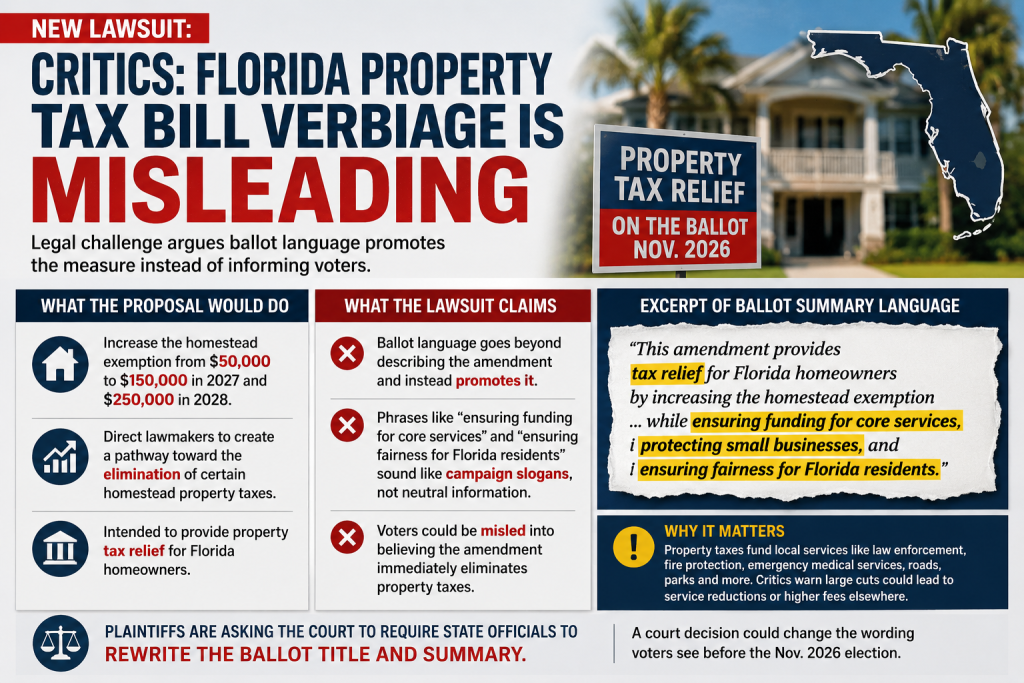
Florida — A growing legal challenge to a proposed Florida constitutional amendment aimed at reducing property taxes is raising questions about whether the wording presented to voters is impartial or designed to persuade support for the measure.
The proposed amendment, backed by Gov. Ron DeSantis and approved by the Legislature for the November 2026 ballot, would significantly expand Florida’s homestead exemption. Supporters say the measure would provide much-needed tax relief to homeowners struggling with rising insurance costs and inflation.
However, critics argue that the language voters will see in the voting booth paints an overly favorable picture of the proposal while omitting important details about its potential impact on local governments and public services.
A lawsuit filed in Leon County Circuit Court by two former Florida mayors and a nonprofit organization alleges the ballot summary is “misleading” because it goes beyond simply describing the amendment and instead promotes it. The complaint argues that phrases such as “ensuring funding for core services,” “protecting small businesses,” and “ensuring fairness for Florida residents” function more like campaign slogans than neutral ballot language.
Under the proposal, Florida’s current $50,000 homestead exemption would increase to $150,000 in 2027 and $250,000 in 2028. The measure would also direct lawmakers to develop a pathway toward the eventual elimination of certain homestead property taxes.
Opponents contend that many voters could mistakenly believe the amendment immediately eliminates property taxes altogether. Attorneys representing the plaintiffs say the actual language of the amendment does not provide for full elimination of property taxes and that the ballot summary could create unrealistic expectations among voters.
The challenge highlights a long-standing principle in Florida election law: ballot summaries must fairly inform voters of the chief purpose of a constitutional amendment without advocating for or against it. Courts have previously removed proposed amendments from the ballot when judges determined the language was confusing, incomplete, or misleading.
Local government officials have also expressed concerns about the financial consequences of the proposal. Property taxes fund many county and municipal services, including law enforcement, fire protection, emergency medical services, road maintenance, parks, and other local operations. Critics warn that substantial reductions in property tax revenue could force local governments to reduce services or seek alternative revenue sources.
Supporters of the amendment argue that Florida homeowners deserve relief after years of rapidly increasing housing costs and property valuations. They maintain that voters should have the opportunity to decide whether current property tax levels are excessive.
The lawsuit does not seek to block voters from deciding the issue. Instead, plaintiffs are asking the court to require state officials to rewrite the ballot title and summary in language they say is more neutral and informative. If a court agrees, Florida’s attorney general could be required to revise the wording before ballots are finalized.
As Florida voters prepare to consider one of the most significant property tax proposals in state history, the legal battle underscores a broader question: Should ballot language simply explain an amendment, or can it also be used to sell it?
The answer may ultimately be decided in court before it is decided at the ballot box.
 5
5 0
0
 20
20